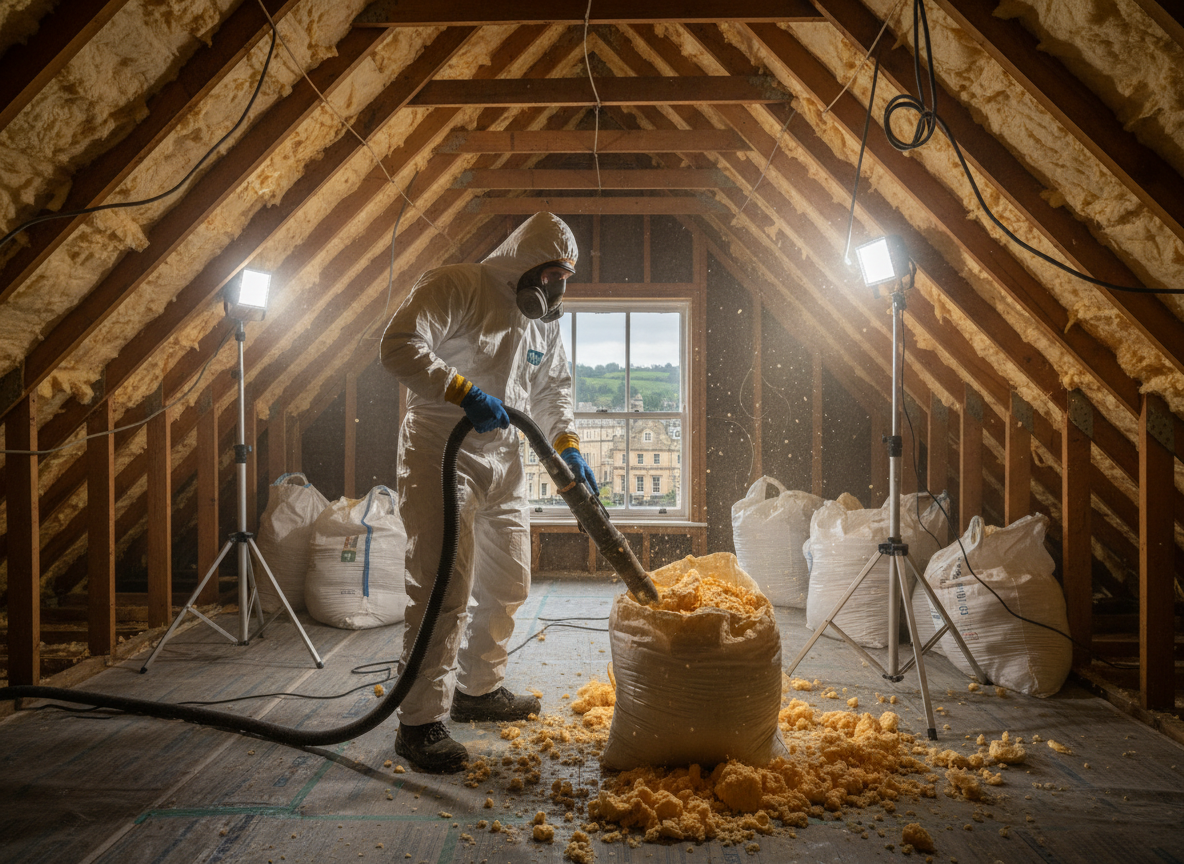
Bath's older properties, particularly those built before 1950 around the city centre and hillsides, often received spray foam insulation in lofts during the 1990s and early 2000s. Over time the closed-cell material traps moisture against rafters and ceiling joists, leading to rot that only becomes visible when the foam is cut away. Removal requires section-by-section cutting and vacuum extraction to avoid disturbing original lath and plaster ceilings below, especially in listed buildings common throughout the BA1 and BA2 postcodes.
The local climate, with frequent winter rainfall and limited loft ventilation in terraced homes, accelerates mould growth once foam starts to degrade. Crews working from Compass Court routinely encounter foam that has bonded directly to stone walls in properties on Lansdown and Camden, requiring hand tools rather than mechanical stripping to prevent damage to the masonry. Disposal must follow Environment Agency rules for expanding foam waste, which adds handling time on every job in the Bath area.
Homeowners in Walcot, Bear Flat and Widcombe often call after noticing musty smells or higher energy bills once the foam has failed. The 24/7 service allows same-day attendance when water ingress is reported, preventing further spread through the tight roof voids typical of Somerset stone terraces. Each extraction leaves the loft ready for proper breathable insulation to be installed later.
Technician insight
In Bath, the thing that catches most people out with Spray Foam Removal near me is how quickly moisture builds up behind the foam in Georgian and Victorian stone terraces on the hills around Circus Mews, where poor loft ventilation turns small leaks into widespread timber decay you only discover once cutting starts.
Blocked Ventilation in a Lansdown Terrace
Homeowner reported musty smell and rising bills in a 19th-century terrace. Inspection showed closed-cell foam had sealed the eaves completely, trapping condensation against rafters. We cut and extracted the foam in sections, cleared the blocked vents, treated surface mould and left the loft ready for new breathable insulation.
How it works
- 1
Site Assessment
Inspect loft access, foam depth and any visible timber or plaster damage in the specific property.
- 2
Containment Setup
Protect ceilings, electrics and stored items before sectioning the foam for removal.
- 3
Sectioned Extraction
Cut and vacuum foam in controlled pieces to limit dust and avoid structural disturbance.
- 4
Timber Inspection
Check rafters and joists for rot or mould before final clean-down and waste removal.
- 5
Final Clearance
Remove all debris and leave the loft ready for follow-on ventilation or insulation work.
Pricing
Cost depends on loft size, foam thickness and access difficulty; upfront quotes provided after inspection.