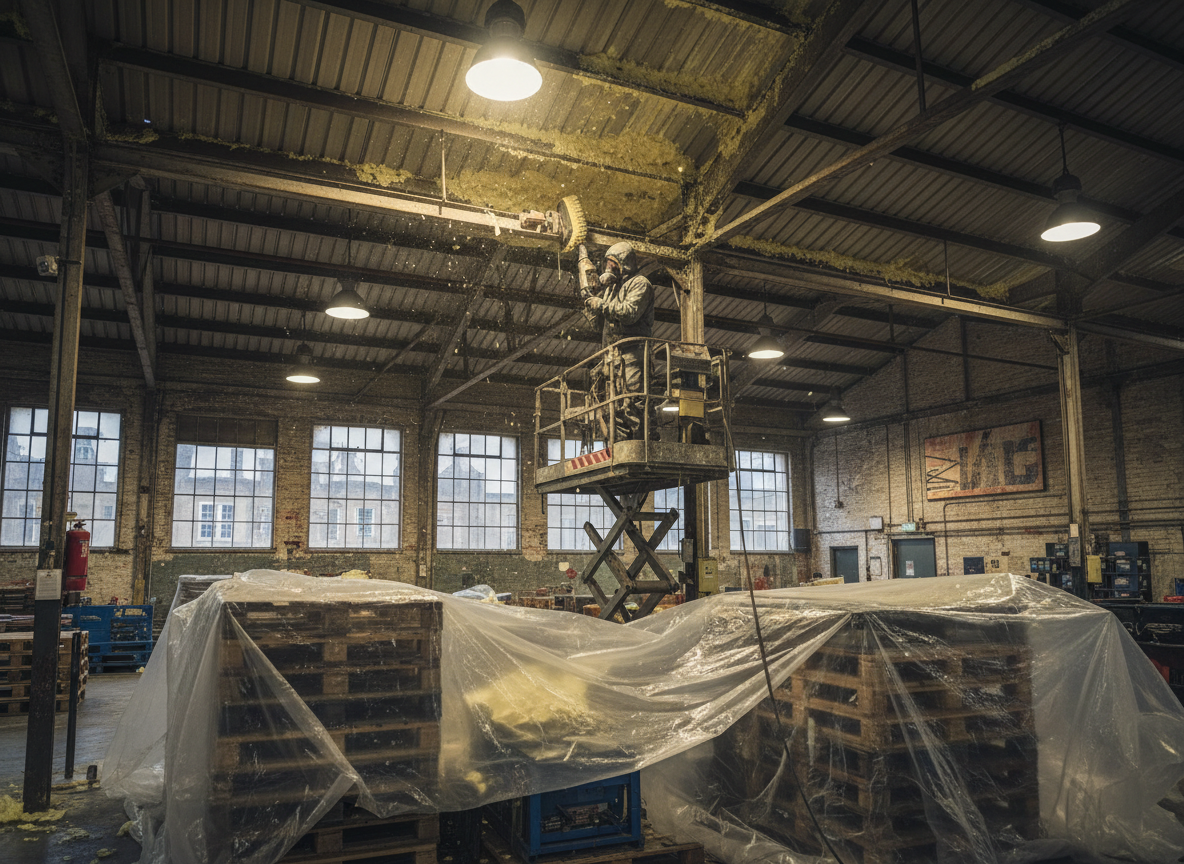
Bath warehouses often sit in converted Georgian or Victorian mills along the River Avon or in the lower Walcot and Widcombe zones where stone walls and high water tables create persistent damp. Spray foam applied years ago traps moisture against these porous substrates, leading to hidden rot in timber joists and accelerated corrosion on metal roof trusses. Removal crews must first map the original building fabric because modern closed-cell foam bonds aggressively to lime mortar and Bath stone, risking structural damage if pulled too aggressively.
Winter rainfall in the Bath area frequently exceeds 80 mm a month, so any warehouse with roof leaks will have foam that has absorbed water and become heavier and more brittle. Technicians therefore stage the job with negative-pressure containment to prevent dust and solvent vapours migrating into adjacent units still in use for storage or light manufacturing. Local planning rules around listed buildings also require careful documentation of any substrate disturbance before work begins.
Edge cases include foam installed over asbestos-containing roof panels common in 1960s light-industrial units near the old gasworks site. In these situations mechanical scraping is avoided until a licensed surveyor has cleared the area. After foam is removed, surfaces are left to dry for at least 48 hours before any new insulation or coating is considered, because residual solvents can react with fresh materials in Bath's humid microclimate.
Disposal routes matter locally because Somerset County Council restricts certain construction wastes at the household recycling centres; contractors therefore arrange direct transfer to licensed facilities in Keynsham or Radstock to keep the project compliant.
Technician insight
In Bath, the thing that catches most people out with Warehouse spray Foam removal is how the surrounding hills funnel damp air into older mill buildings along the river, making foam bond far tighter to stone than it ever does in drier inland counties.
Converted Mill Unit, Lower Bristol Road
Closed-cell foam in a 1970s warehouse extension had trapped condensation against original stone walls. We found widespread timber decay behind the foam layer. We isolated the section, removed the foam in controlled passes, treated the stone and allowed full drying before handover. The owner could then install new dry storage racking without further moisture issues.
How it works
- 1
Site Assessment
Walk-through with moisture metering and substrate testing to identify foam type, thickness and any hidden hazards in the specific Bath warehouse.
- 2
Containment Setup
Erection of sealed barriers and negative air machines to protect neighbouring units and control dust within the Compass Court service radius.
- 3
Foam Extraction
Layered removal using solvents and mechanical tools matched to the foam density and the age of the building fabric.
- 4
Substrate Cleaning and Drying
Neutralisation of residues followed by forced drying and documentation for any listed-building requirements.
- 5
Waste Removal and Handover
Licensed transport of all waste and final walkthrough confirming the space is ready for re-use or new insulation.
Pricing
Pricing depends on warehouse volume, foam thickness, access restrictions and whether listed-building consents are required.