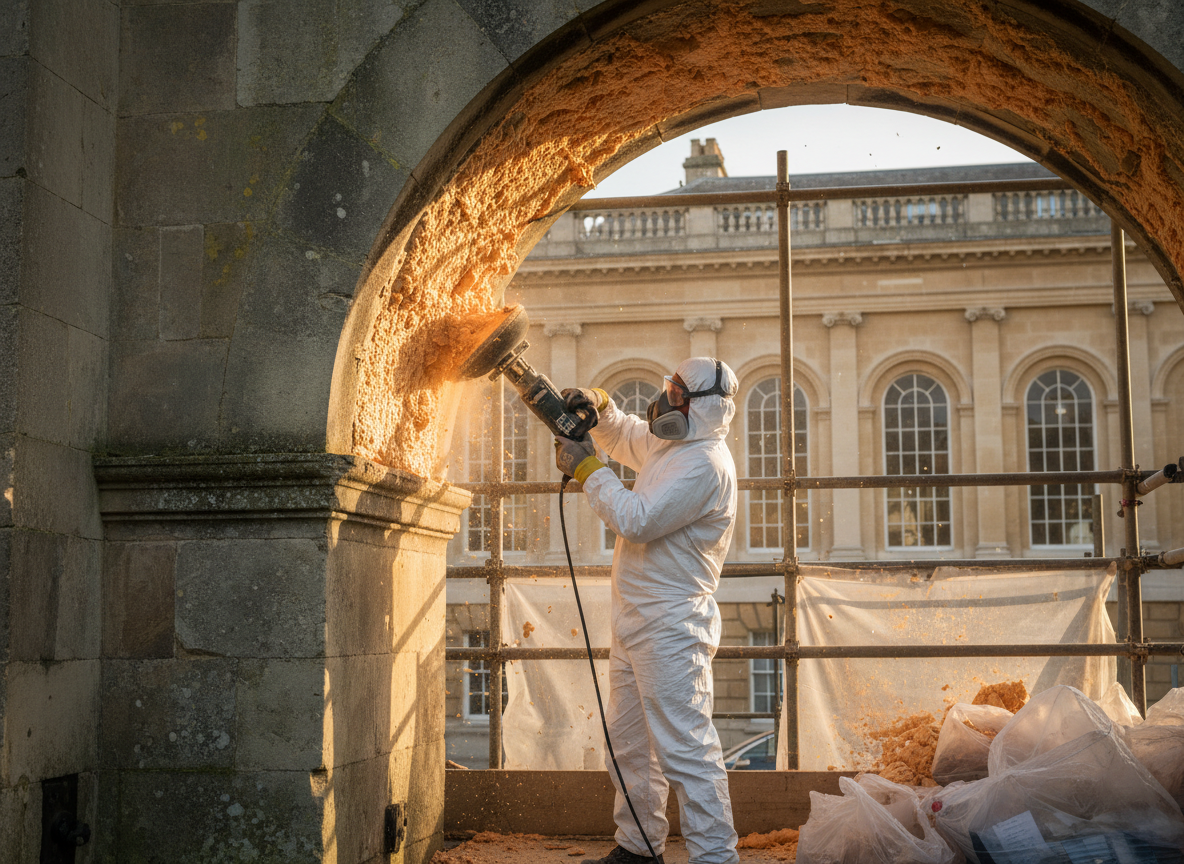
Thermal spray foam removal in Bath often involves older Georgian and Victorian terraces where closed-cell foam was injected into stone cavity walls decades ago. These installations frequently trap moisture against the inner stonework, especially in the damp Bath climate where rainfall and poor ventilation combine. Removal requires sequential cutting and vacuum extraction to avoid cracking the soft Bath stone or dislodging original lime pointing. Technicians must also check for hidden timber lintels that can be compromised by foam expansion over time.
Homeowners in areas such as Circus Mews, Widcombe and Larkhall commonly discover foam has migrated into roof voids and under floorboards during loft conversions. The process demands dust containment because Bath properties sit close together and fine particles travel easily through shared chimneys and party walls. After extraction, surfaces are left ready for new breathable insulation that suits the local stone construction rather than sealing in residual damp.
Regulatory considerations in the Bath conservation area mean any disturbance to external walls must preserve the original appearance. Removal crews therefore work internally wherever possible, using endoscopic cameras to map foam extent before cutting begins. This approach prevents unnecessary Listed Building consent applications while still addressing the thermal bridging and mould issues that originally prompted the foam installation.
Technician insight
In Bath, the thing that catches most people out with thermal spray foam removal is the way foam was pumped behind the random rubble stone in Georgian walls around Circus Mews and Widcombe, creating pockets that only become visible once you start cutting and the trapped damp suddenly appears on the inner face.
Foam Extraction in a Circus Mews Terrace
Homeowners noticed persistent damp patches on internal walls after a previous loft conversion. Inspection revealed closed-cell foam had filled multiple voids behind the stone and migrated under floorboards. We mapped the extent, extracted the foam in controlled sections while protecting the original timber, and left the surfaces clean and dry for new breathable insulation.
How it works
- 1
Site Survey and Mapping
Technicians inspect the property to locate all foam deposits using cameras and moisture meters, noting any hidden voids in stone walls typical of Bath terraces.
- 2
Containment Setup
Dust and debris barriers are installed to protect adjacent rooms and neighbouring properties in dense areas such as Circus Mews.
- 3
Controlled Extraction
Foam is cut and vacuumed in sections, with careful monitoring of stone and timber to prevent damage during removal.
- 4
Surface Preparation and Disposal
Remaining surfaces are cleaned and prepared; all waste is removed from site in accordance with local Somerset disposal rules.
- 5
Final Inspection
A walkthrough confirms complete foam removal and identifies any follow-up ventilation or insulation recommendations.
Pricing
Upfront quotes provided after survey; final cost depends on foam depth, access and property age.