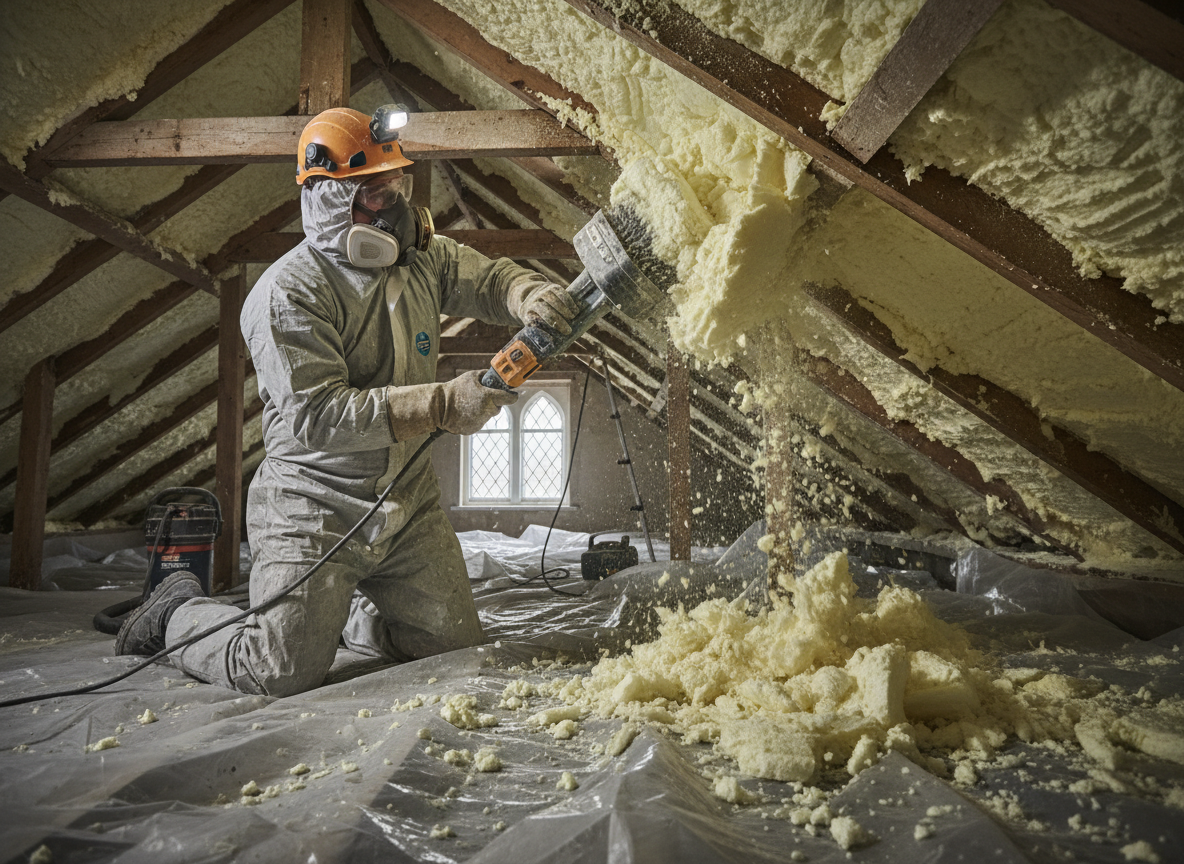
Open cell spray foam removal in Bath often starts with assessing how the material interacts with the city's Georgian and Victorian stone terraces. These buildings frequently have solid stone walls and limited ventilation, which can trap moisture once the foam begins to degrade or was installed over existing damp issues. Crews must carefully separate the foam from lath and plaster without damaging original features, then manage the dust and residue that settles into floor voids common in Circus Mews and surrounding streets.
Bath's mild but persistently wet climate accelerates breakdown of open cell foam, especially where roof leaks or rising damp from the Avon valley affect lower levels. Removal crews typically use negative air machines and HEPA filtration to keep particles out of living spaces in tightly packed terraces. Edge cases include foam that has wicked into timber joists or behind internal stone walls, requiring targeted chiselling and vacuum extraction rather than simple scraping.
Local building regulations around listed properties in Bath mean any removal must avoid altering original fabric or introducing new moisture pathways. Homeowners in areas like Widcombe or Walcot often discover foam was applied directly to breathable stone, creating hidden condensation pockets that only appear after several winters. Proper extraction includes checking for residual isocyanates and ensuring cavities are left ventilated before any new insulation is considered.
Technician insight
In Bath, the thing that catches most people out with open cell spray foam removal is how quickly moisture reappears behind the foam in solid stone walls once it is stripped out. Georgian terraces around the Circus and Royal Crescent often have hidden timber decay that only shows after the foam is gone, and the wet winters mean you cannot just seal it back up without fixing the breathability first.
Open Cell Foam in Walcot Terrace
Homeowner noticed musty smells after heavy rain. We found open cell foam applied directly to rear stone wall in a 19th-century terrace. Extraction revealed saturated joist ends and trapped condensation. After removal and drying, the wall was left ventilated and the smell disappeared.
How it works
- 1
Site Assessment
Inspect foam condition, access points, and moisture levels in Bath stone or timber structures.
- 2
Containment Setup
Seal work zones with plastic sheeting and negative air units to control dust in occupied terraces.
- 3
Foam Extraction
Mechanically remove open cell foam while protecting original lath, plaster, and stone surfaces.
- 4
Clearance and Ventilation Check
Vacuum residues, test for moisture, and confirm cavities can breathe before handover.
Pricing
Cost varies by property age, foam depth and access difficulty in historic Bath buildings.