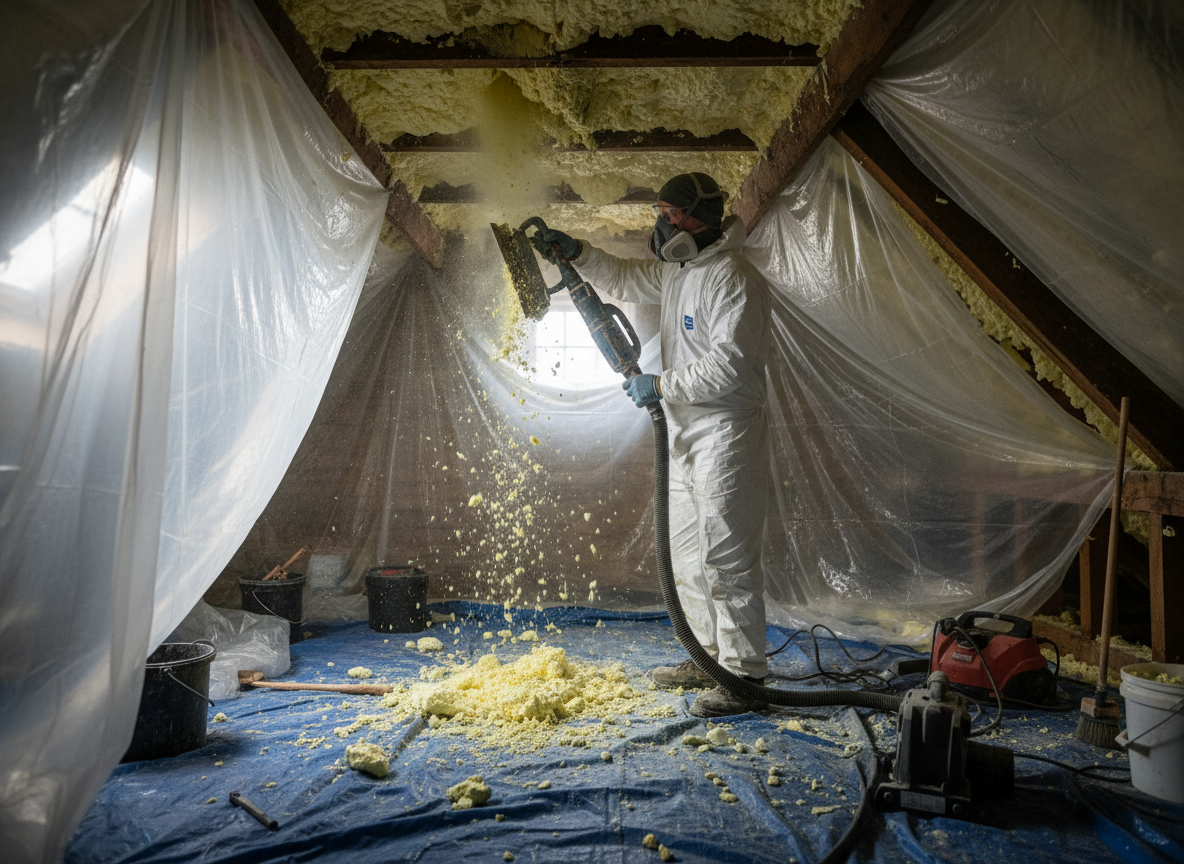
Closed cell spray foam bonds tightly to joists, rafters and stone in Bath's Georgian and Victorian terraces. Removing it requires cutting back to the substrate without damaging original lath or masonry, then extracting the material in sections to avoid releasing trapped moisture that has built up behind the foam. Somerset's frequent rainfall makes this step critical because any remaining foam pockets can hold water against walls that were never designed to be sealed this way.
Bath stone and rubble walls often have uneven surfaces and hidden voids. Technicians must map these voids first because closed cell foam expands into every gap, including between floorboards and into chimney breasts common in Circus Mews and surrounding mews properties. Incomplete removal leaves insulation fragments that can cause condensation once the property is re-ventilated, especially during the damp winter months when temperatures drop and indoor humidity rises.
Work in listed or conservation-area buildings around Bath requires careful sequencing so that original features remain untouched. Dust and debris are contained with negative-pressure setups because fine particles travel easily through the narrow streets and shared chimney stacks of the city centre. After extraction the exposed timber and stone are left to dry naturally before any new insulation is considered.
Technician insight
In Bath the thing that catches most people out with closed cell spray foam removal is how the foam has wicked moisture into the rubble-filled walls of Georgian terraces. Once winter temperatures drop and rain drives against the stone for weeks, those hidden pockets stay wet long after the foam is gone, and homeowners often miss the signs until staining appears on internal plaster.
Mews Terrace Loft Extraction
Closed cell foam had been sprayed across the rafters of a 19th-century mews house near Circus Mews. We found water trapped behind the foam where the Bath stone had drawn rain in through failed pointing. After mapping the voids we removed the foam in sections, ventilated the space and left the timber to dry before the owners arranged repointing.
How it works
- 1
Site Survey and Moisture Mapping
Inspect roof voids, walls and floors in the Bath property to locate all closed cell foam and check for hidden damp.
- 2
Containment and Access Setup
Install dust barriers and negative air units suited to the narrow access typical of mews and terraced houses in the BA1 postcode.
- 3
Sectional Removal
Cut and extract foam in controlled sections, protecting original stone and timber while clearing every bonded area.
- 4
Clearance and Drying Check
Remove debris, ventilate the space and confirm moisture levels have stabilised before handover.
Pricing
Cost depends on access difficulty, depth of foam and property age; 24/7 quotes available from our Circus Mews base.